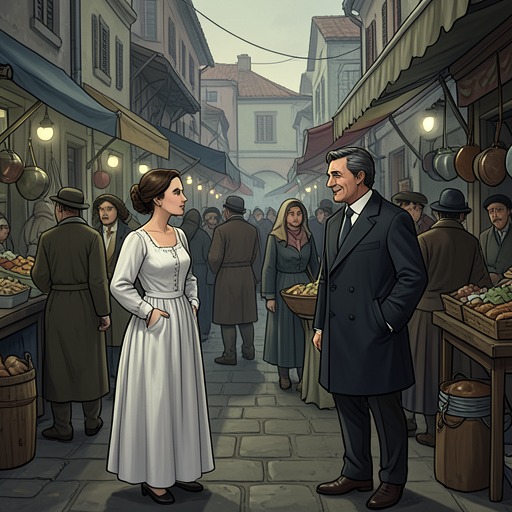
No takebacks, no substitutions
One Thousand and One Nights“No takebacks, no substitutions” is the imp’s warning that a promise in his bargain cannot be withdrawn or exchanged. First delivered with a playful show of insistence, the expression later defines the trap surrounding Della’s inheritance: her father used a third wish to imprison the imp again, but had already promised him something whose terms he had not yet learned.
The Phrase as a Bargaining Rule
The imp introduces the rule while pressing Della’s father to confirm his agreement. He makes him swear first on his third toe and then by the hairs of his chin, seeking repeated assurances before declaring that there can be no takebacks or substitutions. The father answers that he has surrendered nearly everything he owns, save his soul and the clothes he is wearing, and offers the imp any worldly possession he might want. Only then does the imp beckon him closer to reveal what the third gift will be.
The exchange gives the expression its force: the father has agreed before knowing the exact cost. The imp’s rosy-cheeked, mischievous manner makes the demand sound almost like a game, while the repeated oaths and final prohibition establish a binding condition. The gap between the promise and its undisclosed terms is the source of the bargain’s danger.
The Promise and Its Consequences
Years later, Della’s father recounts that he had tried to reason with the imp about the demand for his firstborn child, but the imp would accept no other bargain. He had used his third wish to send the imp back into the lamp, and his first wish to gain knowledge of how to obtain wealth rather than wealth itself. Yet he recognizes that he was foolish to make a third promise before learning what it required. His wife responds that the imp’s repeated insistence on no takebacks and no substitutions makes the mistake all the more painful.
The consequences reach beyond the original agreement. The imp holds Della’s mother’s necklace and her father’s ring as proof of his claim; as Della approaches her twenty-first birthday, a curse is already beginning to affect her memory. Her father fears that when the imp claims her, her inheritance will pass to him as well. The rule thus connects an impulsive promise to both a supernatural claim on Della and a threat to her family’s property.
Recurrence and Contrast
The expression returns at the end of the story in a sharply different kind of exchange. Zaen reminds Della that he has proposed to her a thousand times, but she distinguishes romance from love and explains that she had guarded her heart because she feared his feelings were not for her real self. Zaen’s thousand-and-first attempt is not another demand for marriage on its own terms: he asks Della to be his friend for life as well as his wife. She accepts without gold or jewels, provided he promises to remain her dearest friend.
Against the imp’s rule, the proposal offers a contrast between coerced permanence and mutual commitment. The bargain fixes an unknown obligation before its cost is revealed; Zaen’s final promise answers Della’s plainly stated condition. The repeated motif of promises therefore marks two different kinds of binding speech: one exploits incomplete knowledge, while the other is shaped by what the other person actually wants.